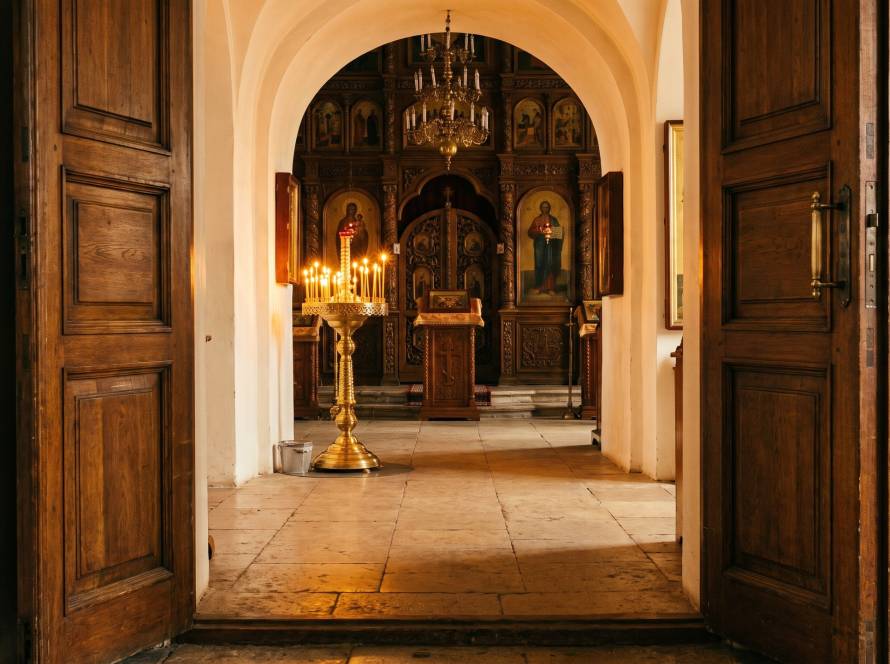
The Great Entrance is the solemn procession during the Divine Liturgy when the priest and deacon carry the bread and wine from the Table of Preparation through the church and into the sanctuary, placing them on the altar to be consecrated as the Body and Blood of Christ.
It’s one of the most dramatic moments in the Liturgy. You’ll know it when you see it.
What Actually Happens
Earlier in the service, during the Proskomide (the preparation), the priest prepared the bread and wine on a small table in the sanctuary called the Prothesis. Now, during the singing of the Cherubic Hymn, he brings those gifts out. The deacon (if there is one) carries the diskos with the bread, and the priest carries the chalice. They process from the sanctuary through the nave where the people are standing, then back through the Holy Doors to the altar itself.
The choir sings: “We who mystically represent the Cherubim, and sing to the life-giving Trinity the thrice-holy hymn, let us now lay aside all earthly cares.” That’s your cue. The procession is happening.
Some people bow. Some make the sign of the cross. Everyone stands. The priest may commemorate the bishop, the parish, specific people by name as he walks. Then the gifts disappear behind the iconostasis, placed on the altar, and the Anaphora begins, the great Eucharistic prayer that will consecrate them.
What It Means
This isn’t just moving dishes from one table to another. The Great Entrance carries layer upon layer of meaning, and the Church has never tried to flatten it into one tidy explanation.
First, it’s an offering. We’re bringing bread and wine (which represent all of creation, the work of human hands, our lives) to God. But we’re not doing this alone. The Cherubic Hymn tells us we’re joining the angels, participating in the heavenly liturgy. The veil between heaven and earth gets thin here.
Second, it’s a funeral procession. The gifts being carried represent Christ going to His voluntary death. Some liturgical commentators connect this directly to Holy Friday, to the burial procession of the King. The altar becomes the tomb. But it’s a tomb that will be empty by the end of the Liturgy, because what goes on that altar will rise as the Body and Blood of the Resurrection.
Third, it’s a royal entrance. Christ the King is entering Jerusalem, entering the temple, entering His kingdom. The procession has that quality, solemn, majestic, purposeful.
All of these meanings are true at once. That’s how Orthodox worship works. We don’t pick one interpretation and discard the others.
How It’s Different from the Little Entrance
There’s another entrance earlier in the Liturgy called the Little Entrance. That one carries the Gospel Book, and it happens before the Scripture readings. The Little Entrance is about the Word, Christ as Logos, the proclamation of the Good News.
The Great Entrance is about the gifts that will become the Eucharist. It’s later, more solemn, and it marks the transition into the most sacred part of the Liturgy. If you miss the Little Entrance, you’ll still know what’s happening. If you miss the Great Entrance, you’ve missed the hinge on which the whole service turns.
What You Do
Stand. Pay attention. Set aside your grocery list and your work schedule and whatever argument you had in the car on the way to church. The hymn literally tells you to lay aside all earthly cares.
You don’t have to do anything fancy. You’re not performing. But you are participating. When the priest walks past you carrying those gifts, you’re part of the procession whether you’re moving or not. You represent the cherubim too.
If you’re still getting used to Orthodox services, the Great Entrance might feel long. That’s okay. Fr. Alexander Schmemann wrote that the Liturgy isn’t trying to be efficient. It’s trying to be true. This procession takes the time it takes because what’s happening matters.
A Practical Note for Southeast Texas
If you work a rotating schedule at one of the plants and you’re trying to make it to Liturgy but you’re running late, try to arrive before the Great Entrance, since everything that follows builds on this moment. The whole service matters, so arrive as early as you can, and talk to Fr. Michael about your situation.
The Great Entrance isn’t a show. It’s not there to give you chills, though it might. It’s the Church doing what Christ told us to do, offering, remembering, becoming part of His death and resurrection. You can’t understand it all at once. You’re not supposed to. Just show up, stand with the angels, and let the procession carry you forward.