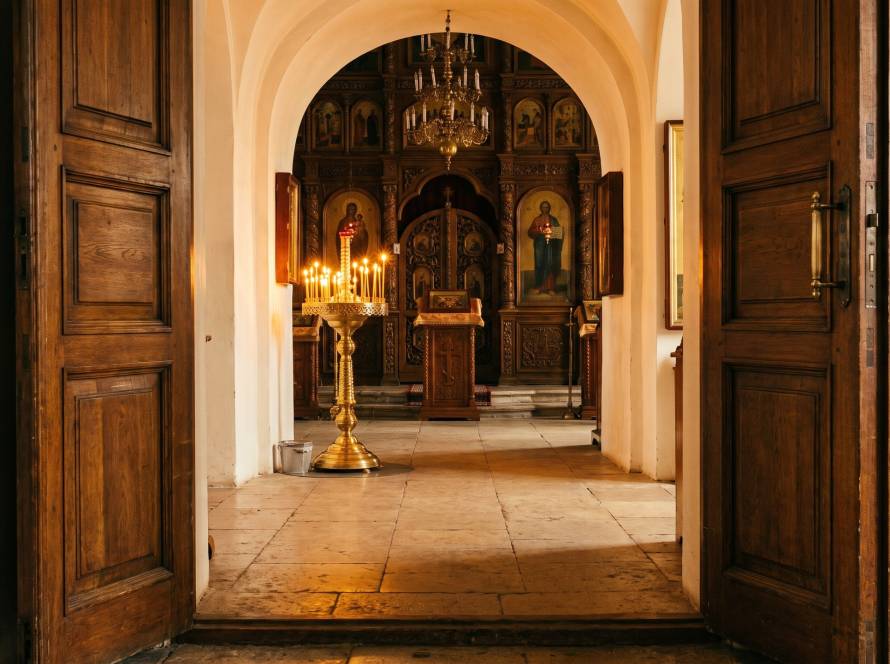
You’re looking at the Orthodox Church, and you’ve found us. The Antiochian Archdiocese has spent the last fifty years learning how to welcome people exactly like you.
Most Antiochian parishes in North America worship primarily in English. We’ve received thousands of converts from Protestant and Catholic backgrounds since the 1970s. Our clergy and parishioners have walked this road before, and they know what questions you’re asking because they asked them too.
Ancient Roots, American Context
Antioch matters. It’s where believers were first called Christians, according to Acts 11:26. The Patriarchate of Antioch is one of the five ancient sees of Christianity, right there with Jerusalem, Alexandria, Constantinople, and Rome. When you walk into an Antiochian parish, you’re connecting with a church that traces its lineage directly to the apostles Peter and Paul.
We’re not asking you to become Middle Eastern. The Antiochian Archdiocese in North America started serving Levantine immigrants in the 1890s, but it changed dramatically in 1975 when Metropolitan Philip reunified the jurisdiction and opened wide the doors to American converts. Since then, we’ve become genuinely multi-ethnic. You’ll find cradle Orthodox from Syria and Lebanon worshiping alongside former Baptists, ex-Catholics, and people who never went to church before they found Orthodoxy.
What You’ll Actually Experience
Walk into most Antiochian parishes and you’ll hear the Divine Liturgy in English. Sermons in English. Church school in English. The coffee hour conversation after Liturgy? Also English, though you might catch some Arabic from the older folks reminiscing about the old country.
Our music is Byzantine chant and four-part choral harmony, sung by voices, not organs or praise bands. The worship is ancient and formal, but it’s not inaccessible. At St. Michael, service books are in the pews so you can follow along. Nobody expects you to know what you’re doing on your first visit. Or your tenth.
The Antiochian approach to converts is patient and structured. If you decide you want to become Orthodox, you’ll go through a catechetical process that usually lasts several months to a year. You’ll learn the faith, attend services, meet with a priest, and gradually be formed into Orthodox life. We don’t do altar calls. Entering Orthodoxy is entering a way of life that will transform you over decades.
The Evangelical Orthodox Story
In 1987, the Antiochian Archdiocese received about two thousand members of the Evangelical Orthodox Church, a group led by Fr. Peter Gillquist and other former Campus Crusade staff who’d spent years studying the early Church. They’d started as evangelicals, tried to recreate apostolic Christianity on their own, and finally realized the ancient Church still existed. Metropolitan Philip welcomed them, catechized them thoroughly, and chrismated them into the Orthodox Church.
That reception changed the character of the Archdiocese. It wasn’t just about preserving an ethnic heritage anymore. It became about bringing ancient Christianity to modern America. Many Antiochian clergy today are converts. They remember what it’s like to struggle with icons, to wonder about praying to saints, to feel lost in a liturgy that lasts two hours.
What This Means for You in Southeast Texas
You probably work rotating shifts at the refinery or the plant. Your family thinks you’ve joined a cult because you’re going to a church that isn’t Baptist or Bible. You’re trying to figure out how to fast when your coworkers want to grab barbecue for lunch.
Antiochian parishes get it. We’ve got members who work offshore, who miss Liturgy because of their schedules, who deal with the same cultural tensions you’re facing. The pastoral approach here tends to be practical, not rigorist. Fasting rules are guidelines for healing, not laws you’ll go to hell for breaking. If you can’t make it to a weekday service because you’re on night shift, nobody’s going to shame you.
The community life matters too. Antiochian parishes tend to emphasize fellowship alongside worship. You’ll find potlucks (and yes, there will be kibbeh and tabouli, but also casseroles and fried chicken). Church school for kids. Adult education classes. Service projects. A choir that’s always looking for more voices. The goal is to build a parish family, not just attend services.
Why It Matters Which Jurisdiction You Choose
Honestly? For most inquirers, it doesn’t matter as much as you think. The Orthodox Church in America, the Greek Archdiocese, the Antiochians, we’re all teaching the same faith, celebrating the same Liturgy, and in communion through the same apostolic succession. If there’s a thriving OCA parish closer to your house than the Antiochian one, go there.
But if you’re choosing between jurisdictions, the Antiochian Archdiocese offers a track record of welcoming converts, a commitment to English worship, and a culture that’s learned to explain Orthodoxy to Americans without watering it down. We’re not trying to make you Greek or Russian or Arab. We’re trying to make you Orthodox.
The Church of Antioch has been doing this for two thousand years. We’ve survived persecutions, heresies, and empires rising and falling. We’re still here, still baptizing, still celebrating the Eucharist, still teaching the faith once delivered to the saints. And we’d be glad to have you join us.