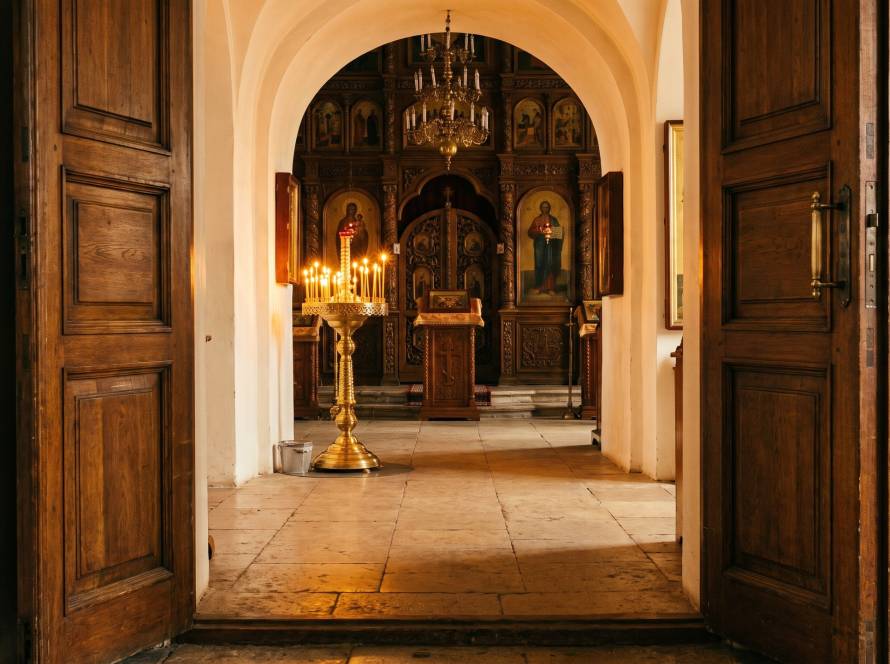
Generally, no. Most Orthodox parishes discourage or prohibit photography during the Divine Liturgy and other services. There are exceptions for weddings, baptisms, and special occasions, but even then you’ll need to ask permission first and follow specific rules.
The short version: talk to the priest before you bring a camera into church.
Why the Restrictions?
The concern is what happens when you’re trying to worship God and someone’s walking around with an iPhone.
Photography turns you into a spectator. You’re framing shots, checking exposure, watching the screen instead of participating in what’s actually happening. The Divine Liturgy isn’t a performance you observe. It’s something you do. You sing, you cross yourself, you venerate icons, you receive Communion. Hard to do any of that when you’re filming.
There’s also the matter of sacred space. The sanctuary isn’t a stage. The royal doors aren’t a backdrop. When someone steps into the altar area to get a better angle or stands on the icon step for an overhead shot, they’re treating holy things like props.
And then there’s everyone else trying to pray. Flash photography during the consecration of the Gifts is distracting at best, irreverent at worst. Nobody wants to be caught on camera while they’re venerating the cross or lighting a candle for their dead grandmother. Those moments are between them and God.
What About Special Occasions?
Baptisms and weddings are different, but not completely different.
Most parishes allow photography at these services, but with rules. No flash during the actual sacrament. Stay in designated areas. Don’t walk behind the priest. For weddings, the Archdiocese’s marriage guidelines say pictures and video may not be taken from behind the priest or in front of the altar. Don’t block people’s view. And absolutely don’t photograph someone receiving Holy Communion without explicit permission (which you probably won’t get).
Some parishes let you take photos before and after the main sacramental action but not during. Others allow a single photographer in a specific location who knows what they’re doing. Every parish handles this differently, which is why you can’t just show up with your camera and assume it’s fine.
If you’re planning a baptism or wedding at an Orthodox church, ask about photography policies when you first meet with the priest. Some parishes have written guidelines they’ll give you. Others will tell you verbally. Either way, get clarity early so your photographer (or your Aunt Linda with her Nikon) knows what to expect.
The Beaumont Context
This can feel strange if you grew up Baptist or non-denominational. You’re used to services where the worship team is backlit and projected on screens, where everything’s designed to be recorded and streamed. That’s not how we do things.
It’s not that we’re against technology. We’re against anything that turns worship into entertainment or reduces the Eucharist to content. If a visiting relative wants to video call the Liturgy to a friend, ask Fr. Michael first. Worship is meant to be prayed in person, not beamed to someone’s living room.
What You Can Do
If you want to remember a special day, ask the priest if you can take photos before or after the service. Most parishes are happy to let you photograph the church, the icons, your family standing near the baptismal font after everyone’s dried off. You can get good pictures without disrupting the service itself.
If you’re visiting and genuinely want a photo for your own records or to show family what an Orthodox church looks like, ask. Priests aren’t ogres. But ask first, and accept the answer you get.
The goal isn’t to make you feel unwelcome or to hide Orthodoxy from the world. The goal is to protect what happens during worship. When we celebrate the Liturgy, heaven and earth come together. The angels are present. The saints are with us. Christ Himself becomes present in the Eucharist. That’s not something you capture on a camera. It’s something you participate in, and that requires your full attention.