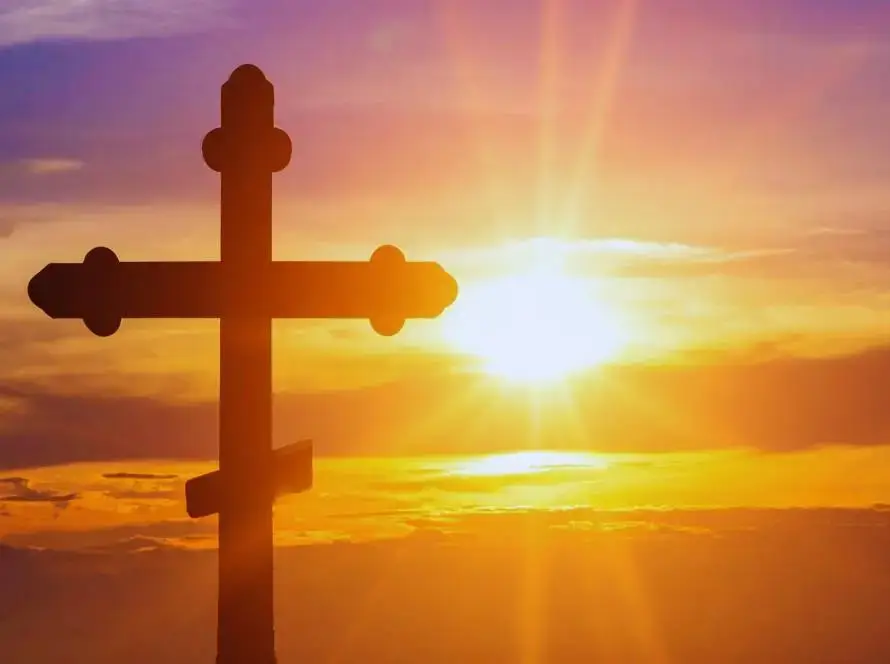
The uncreated light is God himself, coming to us. Not a metaphor. Not a created thing like sunlight or lamplight. It’s the actual energy of God, eternal and without beginning, the same light that blazed from Christ’s face on Mount Tabor when he was transfigured before his disciples.
We Orthodox make a distinction that matters here. God’s essence, what he is in himself, remains completely unknowable. We can’t comprehend it. We can’t reach it. But God doesn’t stay locked away in transcendence. He comes to us through his energies, his actions in the world, and these energies are fully God. The uncreated light is one of these energies. When you encounter it, you’re encountering God himself, not some lesser created thing he made.
What the Apostles Saw
On Mount Tabor, Peter, James, and John saw Christ shining. The Gospel says his face shone like the sun and his clothes became white as light. This wasn’t stage lighting. It wasn’t a trick. Christ revealed his divinity, the same glory he’d always possessed but which his human flesh had veiled. The apostles’ eyes were opened by the Holy Spirit to see what was already there.
That light didn’t start existing on the mountain. It’s always been. It permeates all creation right now, holding everything in existence. Most of us just can’t see it yet.
A Fourteenth-Century Fight
In the 1300s, a monk named Barlaam from Calabria started criticizing the hesychasts, monks on Mount Athos who practiced inner stillness and prayer. These monks sometimes spoke of seeing divine light in their prayer. Barlaam thought this was nonsense, or worse, heresy. He said if they were seeing light, it had to be created light, something less than God.
St. Gregory Palamas, himself an Athonite monk, defended the hesychasts. He articulated what the Church had always believed but hadn’t needed to define so precisely before. God’s essence is unknowable, yes. But his energies, his light, his grace, his presence, are uncreated and fully divine. We can participate in these energies without comprehending God’s essence. The Church affirmed Palamas at councils in the 1340s and 1350s. His teaching became official Orthodox doctrine.
This isn’t some obscure theological debate for academics. It means we can actually encounter God. Not just think about him or follow rules about him, but meet him.
How It Comes to Us
You don’t manufacture this experience. You can’t technique your way into seeing the uncreated light. It’s grace, God’s initiative. But the tradition does teach us how to prepare ourselves, how to become receptive. Prayer, especially the Jesus Prayer practiced in stillness. Fasting. Confession. The sacraments. Purification of the heart from passions that cloud our spiritual vision.
Some saints have seen it with their physical eyes, blazing from icons or filling a church. Others perceive it inwardly during prayer, an infinite light that seems to know them, to love them, to teach them things beyond words. Fr. Sophrony Sakharov, a monk who lived on Mount Athos and later in England, wrote about these experiences. His book “We Shall See Him as He Is” describes the uncreated light as something you enter into, like being immersed in an endless sea.
Most of us won’t have dramatic visions. That’s fine. The light still works on us through the mysteries, through prayer, through the slow transformation the Church calls theosis. We’re being changed from glory to glory, as St. Paul says, into the same image.
Why It Matters in Beaumont
This might sound abstract if you’re used to churches that focus mainly on Bible study and making good moral choices. But Orthodox Christianity is about union with God, not just information about God. The uncreated light is how we talk about God’s real presence with us, in us, changing us.
When you stand in the Divine Liturgy and the priest censes the icons, when light filters through the incense smoke, you’re surrounded by reminders of this reality. The gold backgrounds in icons represent the uncreated light. The saints depicted there lived in that light and still do. They’re not dead. They’re more alive than we are, fully illuminated.
Christ told us we’re the light of the world. Not that we generate our own light, but that we can become transparent to his. That’s what we’re here for. That’s what the Christian life is, becoming people who shine with a light that isn’t ours, that has no beginning, that won’t burn out when the sun dies.
If this interests you, come to a service. Stand in the lamplight and candlelight of our small temple and know that another Light, uncreated and eternal, is there too. You might not see it yet. But it sees you.